The Product Discovery Judgment Framework
A complete system for building discovery capability: an essential Human Foundation, Structured Process and Judgment at its core, with AI Partnership as an optional accelerator.
The Inner Work That Makes Discovery Possible
Everything above this layer assumes you can do genuinely difficult things. Validating a hypothesis means admitting you might be wrong. Synthesising disconfirming evidence means hearing what you do not want to hear. Deciding at a gate means committing with incomplete information. Process compliance without human development produces performative discovery: going through the motions while protecting yourself from the discomfort of genuine learning.
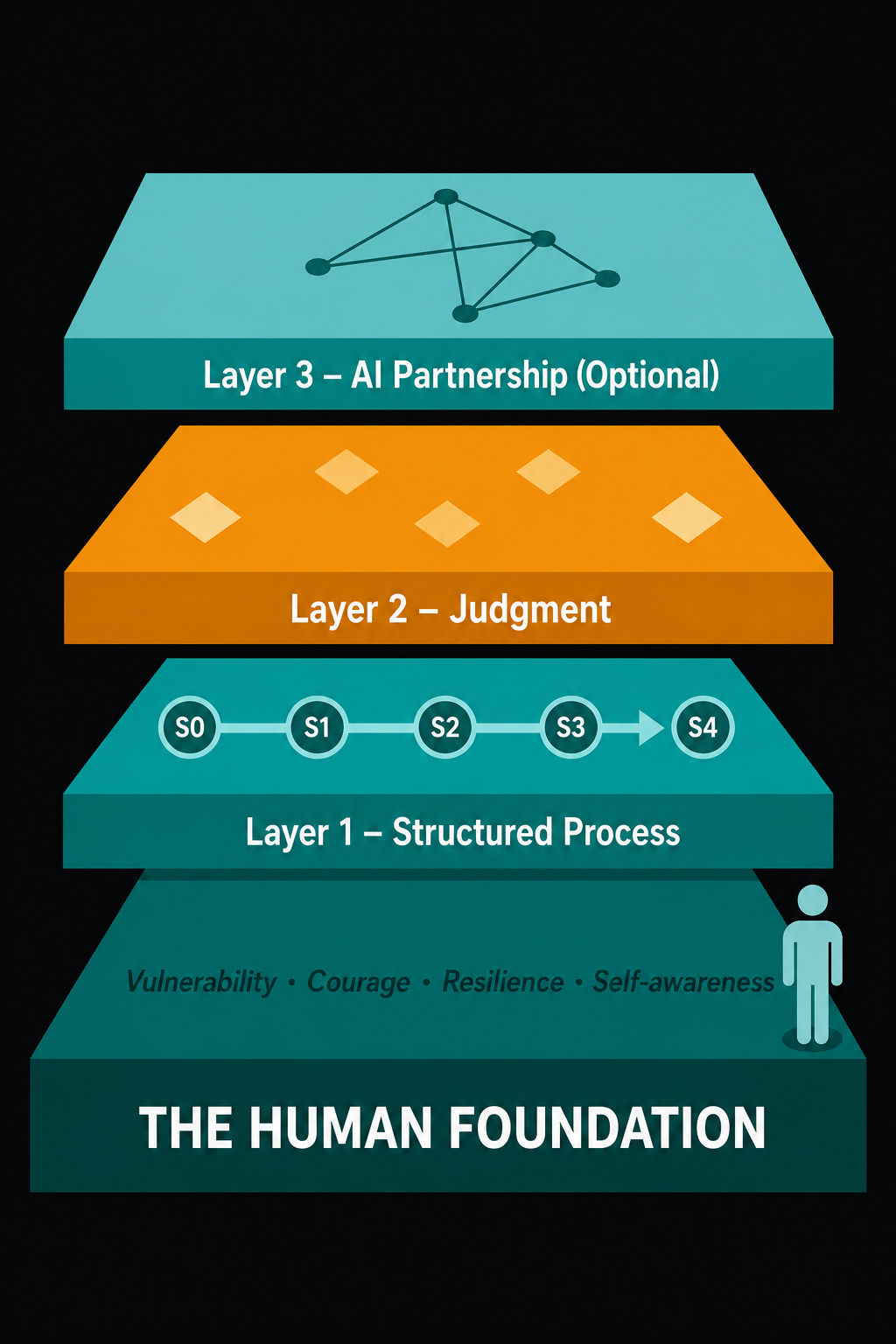
You cannot learn if you cannot admit you do not know. "I don't know" and "I was wrong" are professional strengths. The moment you defend instead of learn, discovery stops.
With AI: without vulnerability, AI's false confidence becomes your false confidence.
Not the absence of fear, but action despite it. Every gate decision is a courage test. Proceed, Iterate, Pivot and Stop are easy to say and hard to do when your reputation or identity is at stake.
With AI: AI can give you the evidence. It cannot give you the nerve to present it.
Not the absence of disappointment, but recovery and continuation. Hypotheses fail, users reject solutions, and months of work end in a decision to stop. Your ideas are not your identity.
With AI: uncomfortable findings now arrive faster than you are emotionally ready for them.
You cannot eliminate your biases, but you can learn to recognise them. Confirmation bias, sunk cost, authority bias, optimism bias. Self-awareness is the first step toward self-correction.
With AI: confirmation bias plus AI's confident delivery is a dangerous combination.
These four capacities are the individual level. The work also happens at team level, where psychological safety determines whether people share messy thinking or only polished conclusions, and at organisational level, where incentives and permission decide whether discovery is possible at all. Progress at any level helps the others.
They are not abstract virtues. They show up at specific moments. JP3, Problem Framing, requires the courage to question assumptions. JP14, Confidence Assessment, requires the self-awareness to recognise your own optimism bias.
The human foundation is not separate from the judgment framework. It is what makes the framework work.
Five Stages. Four Gates.
A repeatable path from initial signal to confident decision. At every gate, evidence determines whether to proceed, iterate, pivot, or stop.
Discovery
Design
The process gives you structure. But structure alone isn't enough. You also need to see where judgment happens inside it.
19 Decisions That Determine Outcomes
Every critical decision is explicit, visible, and improvable. These are the moments where human judgment determines whether discovery produces insight or theatre.
- JP1 Signal Evaluation
- JP2 Customer Segment Selection
- JP3 Problem Framing
- JP4 Opportunity Prioritization
- JP5 Scope Definition
- JP6 Solution Generation
- JP7 Solution Selection
- JP8 Assumption Identification
- JP9 Risk Prioritization
- JP10 Prototype Scope
- JP11 Test Design
- JP12 Evidence Interpretation
- JP13 Signal vs. Noise
- JP14 Confidence Assessment
- JP15 Proceed / Pivot / Stop
- JP16 Success Metrics Definition
- JP17 Monitoring Signal Selection
- JP18 Outcome Interpretation
- JP19 Learning Extraction
Without explicit judgment points, critical decisions are invisible, inconsistent, and unimprovable.
Making judgment visible is essential. But in practice, you also need to decide how AI fits into each stage, and where it doesn't.
Three Modes of Collaboration
AI accelerates work within each stage. Humans own judgment at every gate and decision point.
- Transcription and data aggregation
- Scoring calculations
- Document generation
- Report assembly
- Pattern clustering and gap identification
- Cross-reference analysis
- Consistency checking
- Draft generation and visualization
- "Have you considered…"
- "Your evidence gaps are in…"
- "What would change your confidence?"
- Challenges assumptions and prompts reflection
Put the framework to work
Explore a discovery effort or learn the method step by step.
Working with a team? Explore live training.