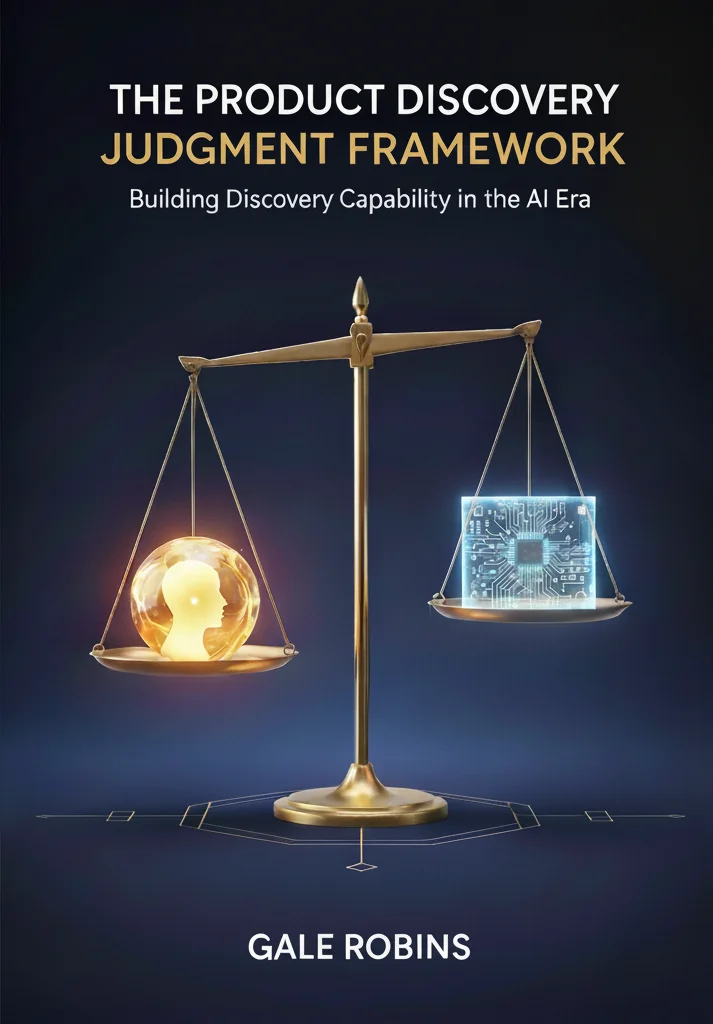
Coming Soon

The Product Discovery Judgment Framework

Building Discovery Capability in the AI Era

18 chapters covering the complete framework. From the philosophy of judgment-driven discovery to practical implementation of every judgment point.

What's Inside

  • The 5-stage discovery process explained
  • Deep dive on all 19 judgment points
  • Gate decisions and criteria
  • JTBD artifact chain methodology
  • AI-human partnership patterns
  • FeedLoop case study throughout

↓ Read Chapter 1 below

Chapter 1: The New Discovery Imperative

When building became easy, deciding became hard.

The team shipped five features in three months. By any traditional measure, they were killing it. Sprints completed on time. Velocity climbing. Stakeholders impressed by the pace. Their AI-assisted development workflow had cut implementation time in half, and they'd used every hour of savings to ship more.

Six months later, three of those features had been quietly deprecated. Fewer than eight percent of customers used a fourth. The fifth—the one that took the most effort—had become a support burden that consumed more resources than it saved.

When the VP of Product asked what went wrong, no one could answer. Not because they didn't have data, but because they'd never paused to ask whether any of it should have been built in the first place. They had validated nothing. They had assumed everything. They had moved fast and built the wrong thing.

This isn't a cautionary tale about one dysfunctional team. It's the norm. Industry data tells the same story across sectors: only about one-third of software projects fully meet their original goals, requirements, and timelines. Ninety percent of startups fail, with the most common cause being "no market need." An estimated eighty percent of features in the average software product are rarely or never used.

These are not execution failures. They are failures to validate what was worth building in the first place. We've gotten very good at building. We haven't gotten better at deciding what to build.

Think about features you've seen shipped by your team or others. How many delivered the outcomes expected? How confident were the teams before launch? What evidence informed that confidence?

1.1 The Paradox of Progress

We can build faster than ever. And we're wasting more effort than ever.

The paradox is real: the easier building becomes, the more critical it is to know what's worth building. When implementation was the bottleneck, the cost of a wrong decision was somewhat self-limiting. You couldn't build that many wrong features because building was slow and expensive. Now you can. And teams do.

A decade ago, implementing a moderately complex feature might have taken a quarter. The time investment alone forced deliberation. Today, that same feature might take two weeks—or two days with proper AI assistance. The friction that once created space for reflection has evaporated.

This isn't a complaint about AI or modern tooling. These advances are genuinely valuable. The problem is that we've accelerated one part of the system without upgrading the others. We've given product teams a sports car but left them navigating with a paper map.

FeedLoop, a composite case study we'll follow throughout this book, experienced this pattern firsthand. They built an MVP that let companies collect and organize feedback. Users said the tool was "fine." Usage data told a different story: seventy-eight percent of users stopped logging in after initial setup. A churned customer captured the problem perfectly: "We're still making decisions the same way we did before your tool."

That single sentence would redirect their entire product strategy. But only because they paused to listen.

Project failure. Startup failure. Unused features. AI pilot collapse. Different symptoms, same underlying cause: decisions made before evidence existed. Teams commit resources, hire engineers, and build roadmaps based on assumptions that feel obvious but have never been tested.

This isn't a problem of incompetence. It's a problem of process. Without structured discovery, even talented teams confuse confidence with validation.

The uncomfortable truth is that speed amplifies whatever direction you're heading. If you're heading somewhere valuable, speed is an asset. If you're heading somewhere worthless, speed just gets you there faster.

1.2 The Shift: From Prediction to Judgment

In Power and Prediction, economists Ajay Agrawal, Joshua Gans, and Avi Goldfarb offer an insight that transforms how we should think about what AI changes: AI is fundamentally a prediction technology. As prediction gets cheaper—and it's getting dramatically cheaper—the economic value shifts to something AI can't provide: judgment.

Judgment determines which predictions matter. It weighs competing options against values and priorities. It translates "what is likely" into "what should we do."

Agrawal and his coauthors illustrate this with a historical parallel. When factories first installed electricity, productivity didn't improve. Electrical power simply replaced steam engines while factory floor layouts remained unchanged. Only when manufacturers redesigned their entire operations to take advantage of electricity's possibilities did productivity surge. The resistance wasn't the technology; it was the resistance to rethinking the system.

The same pattern applies to AI in product discovery. Teams that add AI tools to existing discovery processes see modest gains at best. The real opportunity lies in redesigning discovery itself: new workflows that leverage AI's predictive capabilities, new decision points that focus human judgment where it matters most.

This is the discovery imperative: in a world of cheap prediction, judgment is the competitive advantage. Teams that build deliberate judgment capabilities—structured processes for making and improving decisions under uncertainty—will systematically outperform those that don't. Not because they're smarter, but because they've invested in the capability that differentiates outcomes.

Chapter 4 develops this AI-human partnership framework in detail. For now, note the principle: AI accelerates prediction; humans must own judgment. The integration determines outcomes.

1.3 Why Traditional Discovery Falls Short

Product discovery isn't new. The basic idea—learning what to build before building it—has been core to product management for decades. So why isn't existing discovery practice sufficient?

Three structural problems.

First, traditional discovery was designed for a slower world. The canonical discovery frameworks emerged when implementation was the bottleneck. They assumed you had time for extensive upfront research because the alternative—building the wrong thing—was so expensive.

That assumption no longer holds. When you can prototype in hours rather than months, the discovery process can't take quarters. But simply compressing traditional discovery doesn't work. You end up with shallow research, rushed synthesis, and decisions based on inadequate evidence. Speed without structure produces motion without progress.

Second, traditional discovery has no judgment layer. Most discovery frameworks describe activities—interviews, prototyping, testing—but not the decisions those activities inform. They'll tell you to validate your riskiest assumptions but not how to assess which assumptions are riskiest. They'll recommend testing with users but not how to interpret ambiguous results.

This gap matters enormously. Two teams can execute identical discovery activities and reach opposite conclusions—not because one team did the activities wrong, but because they exercised judgment differently. Without explicit attention to judgment quality, discovery becomes a black box where inputs don't reliably predict outputs.

The missing piece is what this book calls Judgment Points: explicit moments in the process where human assessment determines quality. Making these judgment moments visible is what allows judgment to improve.

Third, traditional discovery doesn't account for AI as a partner. The discovery frameworks most teams use were designed for fully human processes. AI, if considered at all, shows up as a tool for specific tasks—transcribing interviews, perhaps, or analyzing survey data.

This dramatically underestimates both AI's potential contribution and the risks of getting the partnership wrong. AI can now participate meaningfully across nearly every discovery activity. But it can also introduce errors that feel authoritative, amplify biases in training data, and generate plausible-sounding nonsense.

The question isn't whether to use AI in discovery—that ship has sailed. The question is how to structure the partnership so that AI handles what it does well while humans retain what they must do.

1.4 Discovery Reimagined

What would discovery look like if we designed it for this moment? If we built a system where AI acceleration and human judgment reinforce each other?

Three components, working together.

A structured process that scales with speed. Not discovery compressed, but discovery redesigned. Clear stages with defined activities and artifacts. Decision gates that force explicit choices. Feedback loops that compound learning across cycles. Chapter 2 introduces this five-stage process.

A judgment layer that makes quality visible. Explicit Judgment Points throughout the process—moments where human assessment determines quality. Clear indicators of what good judgment looks like. Calibration practices that help teams develop better judgment over time. Part Three develops the nineteen Judgment Points and quality framework.

An AI partnership model that amplifies both. Defined roles for AI across activities: what AI should handle, what humans must retain, and where verification is essential. Chapter 4 establishes the partnership framework; Chapter 15 provides activity-level guidance.

None of these components works well alone. Process without judgment produces activity without quality. Judgment without process produces inconsistent decisions. AI without boundaries produces plausible-sounding nonsense. The integration is the point.

One more shift: discovery isn't a phase you complete before building. It's a continuous capability that runs alongside delivery. Each cycle produces learning that improves the next. Teams that treat discovery as a one-time gate miss the compounding benefits—the judgment that sharpens with each iteration.

We'll follow FeedLoop through a complete discovery cycle, from the initial signal that something was wrong through validation and handoff. Their journey illustrates how the framework operates in practice—including where they struggled, what they learned, and how their judgment improved across cycles.

The promise isn't that discovery becomes easy. It doesn't. Genuine learning under uncertainty is inherently uncomfortable. The promise is that discovery becomes effective: that the time and effort you invest produces reliable learning rather than expensive motion.

Chapter Summary

  • Building has gotten dramatically faster, but outcomes haven't improved proportionally—the bottleneck has shifted from implementation to decision-making.
  • The paradox of progress: the easier building becomes, the more critical it is to know what's worth building.
  • Agrawal's insight: as AI makes prediction cheap, judgment becomes the valuable human contribution.
  • Traditional discovery falls short because it was designed for slower cycles, lacks an explicit judgment layer, and doesn't account for AI partnership.
  • Discovery reimagined combines structured process (the container), visible judgment quality (the differentiator), and deliberate AI partnership (the accelerator).
  • The integration matters: process without judgment produces activity; judgment without process produces inconsistency; AI without boundaries produces plausible-sounding nonsense.
  • When prediction becomes cheap, judgment becomes your competitive advantage.

Judgment is the competitive advantage. But judgment doesn't operate in a vacuum—it needs a structure that creates the right conditions for good decisions at the right moments. The next chapter introduces that structure: a five-stage process with decision gates that turns discovery from random exploration into systematic learning.